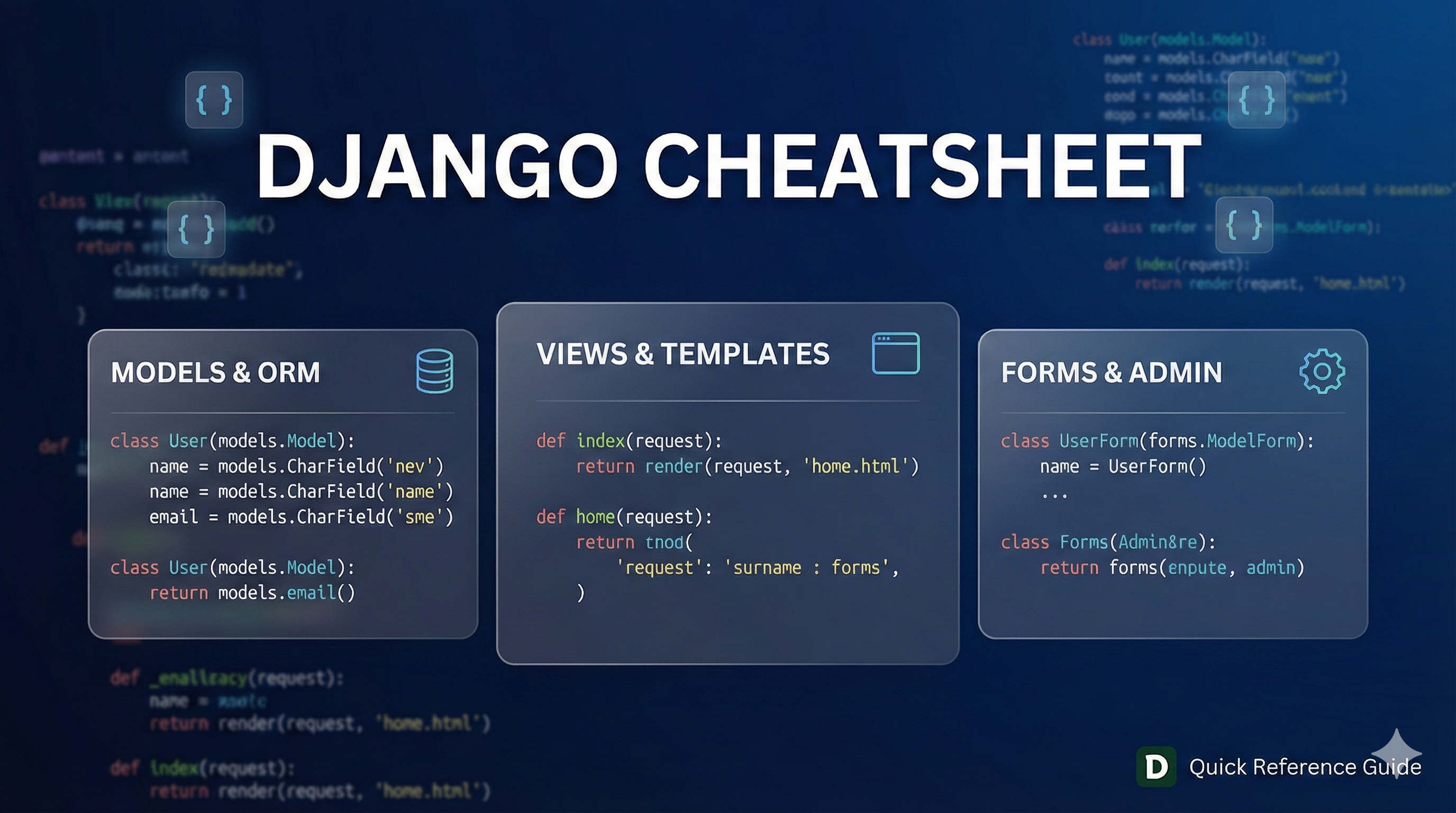
Django Cheatsheet
This cheatsheet covers commonly used Django commands, core concepts, and practical snippets for day‑to‑day development.
1. Project & App Setup
Create Virtual Environment
python -m venv venv
source venv/bin/activate  # Linux/Mac
venv\\Scripts\\activate     # Windows
Install Django
pip install django
Create Project
django-admin startproject project_name
cd project_name
Create App
python manage.py startapp app_name
Run Development Server
python manage.py runserver
python manage.py runserver 0.0.0.0:8000
2. Settings & Configuration
Register App
INSTALLED_APPS = [
    'app_name',
]
Database (PostgreSQL Example)
DATABASES = {
    'default': {
        'ENGINE': 'django.db.backends.postgresql',
        'NAME': 'db_name',
        'USER': 'user',
        'PASSWORD': 'password',
        'HOST': 'localhost',
        'PORT': '5432',
    }
}
Static & Media Files
STATIC_URL = '/static/'
STATIC_ROOT = BASE_DIR / 'staticfiles'

MEDIA_URL = '/media/'
MEDIA_ROOT = BASE_DIR / 'media'
3. Models
Basic Model
from django.db import models

class Product(models.Model):
    name = models.CharField(max_length=255)
    price = models.DecimalField(max_digits=10, decimal_places=2)
    created_at = models.DateTimeField(auto_now_add=True)

    def __str__(self):
        return self.name
Common Fields
-
CharField
-
TextField
-
IntegerField
-
BooleanField
-
DateField / DateTimeField
-
ForeignKey
-
OneToOneField
-
ManyToManyField
4. Migrations
python manage.py makemigrations
python manage.py migrate
python manage.py showmigrations
python manage.py sqlmigrate app_name 0001
5. Django ORM (Queries)
Create
Product.objects.create(name="Book", price=100)
Read
Product.objects.all()
Product.objects.get(id=1)
Product.objects.filter(price__gte=100)
Update
product = Product.objects.get(id=1)
product.price = 120
product.save()
Delete
Product.objects.filter(id=1).delete()
Query Helpers
from django.db.models import Q, Count, Sum

Product.objects.filter(Q(price__gt=100) | Q(name__icontains="pen"))
Product.objects.aggregate(total=Sum('price'))
6. Admin Panel
Create Superuser
python manage.py createsuperuser
Register Model
from django.contrib import admin
from .models import Product

@admin.register(Product)
class ProductAdmin(admin.ModelAdmin):
    list_display = ('name', 'price')
7. Views
Function‑Based View (FBV)
from django.http import HttpResponse

def home(request):
    return HttpResponse("Hello World")
Class‑Based View (CBV)
from django.views import View
from django.http import HttpResponse

class HomeView(View):
    def get(self, request):
        return HttpResponse("Hello World")
8. URLs
App URLs
from django.urls import path
from .views import home

urlpatterns = [
    path('', home, name='home'),
]
Include in Project URLs
from django.urls import path, include

urlpatterns = [
    path('', include('app_name.urls')),
]
9. Templates
Template Settings
TEMPLATES = [
    {
        'DIRS': [BASE_DIR / 'templates'],
    },
]
Template Syntax
{{ variable }}
{% if user.is_authenticated %}
{% for item in items %}
{% endfor %}
10. Forms
ModelForm
from django.forms import ModelForm
from .models import Product

class ProductForm(ModelForm):
    class Meta:
        model = Product
        fields = '__all__'
11. Authentication
Login Required
from django.contrib.auth.decorators import login_required

@login_required
def dashboard(request):
    pass
Custom User Model
from django.contrib.auth.models import AbstractUser

class CustomUser(AbstractUser):
    phone = models.CharField(max_length=20, blank=True)
12. Middleware
MIDDLEWARE = [
    'django.middleware.security.SecurityMiddleware',
    'django.contrib.sessions.middleware.SessionMiddleware',
]
13. Signals
from django.db.models.signals import post_save
from django.dispatch import receiver
from .models import Product

@receiver(post_save, sender=Product)
def product_created(sender, instance, created, **kwargs):
    if created:
        print("Product Created")
14. Django REST Framework (Quick)
Install
pip install djangorestframework
Serializer
from rest_framework import serializers
from .models import Product

class ProductSerializer(serializers.ModelSerializer):
    class Meta:
        model = Product
        fields = '__all__'
API View
from rest_framework.views import APIView
from rest_framework.response import Response

class ProductAPI(APIView):
    def get(self, request):
        return Response({"status": "ok"})
15. Management Commands
python manage.py shell
python manage.py collectstatic
python manage.py flush
python manage.py check
16. Deployment Essentials
-
DEBUG = False -
Set
ALLOWED_HOSTS -
Use
.envfor secrets -
Configure Gunicorn / uWSGI
-
Nginx as reverse proxy
17. Useful Django Packages
-
django‑rest‑framework
-
django‑filter
-
django‑cors‑headers
-
django‑allauth
-
celery
-
django‑debug‑toolbar
18. Common Shortcuts
get_object_or_404(Model, id=1)
redirect('url_name')
reverse('url_name')
19. Security Basics
-
CSRF protection enabled
-
Use Django ORM (avoid raw SQL)
-
Validate user input
-
Hash passwords (default)
20. Debugging
python manage.py shell_plus # django‑extensions
This cheatsheet is suitable for quick reference during Django development and interviews.